

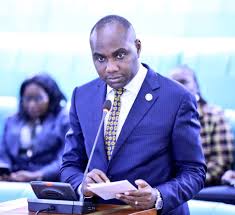
Finance Minister Henry Musasizi has unveiled his maiden National Budget, a record Shs84.39 trillion, for the 2026/27 financial year, committing Shs5.23 trillion to the health sector in a bid to strengthen domestic healthcare systems and reduce reliance on donor support.
Presenting his maiden budget speech during a special sitting of Parliament at Kololo Ceremonial Grounds on Thursday, Musasizi outlined the government’s economic agenda under the theme: “Full Monetization of Uganda’s Economy through Commercial Agriculture, Industrialization, Expanding and Broadening Services, Digital Transformation and Market Access.”
The budget is the first to implement the NRM government’s 2026–2031 manifesto and the Fourth National Development Plan (NDP IV), while also laying the groundwork for Uganda’s anticipated graduation from Least Developed Country status in March 2027.
A major focus of the budget is healthcare, with government directing significant resources toward expanding specialised treatment services, improving access to medicines and strengthening emergency response systems.
According to Musasizi, the Shs5.23 trillion allocation will support maternal and child health programmes, nutrition interventions, immunisation, prevention and treatment of non-communicable diseases, provision of essential medicines, specialised healthcare services and preparations for Universal Health Coverage.
One of the centrepieces of the health budget is increased funding for the National Medical Stores (NMS), which will receive an additional Shs145.33 billion. This raises the agency’s total funding envelope to Shs862.93 billion.
The minister said the increased allocation is intended to reduce Uganda’s dependence on external donors for critical medical supplies.
The funding will support continued availability of antiretroviral drugs, anti-malarial medicines, childhood vaccines, tuberculosis treatment and laboratory diagnostic supplies.
Government is also investing heavily in specialised healthcare infrastructure aimed at reducing the number of Ugandans seeking treatment abroad.
Musasizi reported that 17 Regional Referral Hospitals and 25 General Hospitals have been equipped with Neonatal Intensive Care Units (NICUs), while 14 Regional Referral Hospitals have received CT scan machines.
He highlighted several achievements recorded over the past year, including 634 specialised cardiac procedures conducted by the Uganda Heart Institute and the country’s first successful bone marrow transplant performed by the Uganda Cancer Institute in April 2026.
The minister also reported that immunisation coverage among children under one year reached 94 percent and that 31 health facilities are under construction across the Karamoja sub-region.
Several flagship health projects are expected to progress significantly during the financial year.
The Nuclear Medicine (PET) Centre for cancer treatment is now 95 percent complete in its first phase, while the second phase stands at 10 percent completion.
Meanwhile, the 250-bed Cardiac Hospital in Naguru is 44 percent complete and is expected to be finished by June 2027.
The International Specialized Hospital of Uganda in Lubowa has reached 75 percent completion, with commissioning anticipated in December 2027.
Government also reported that medical waste incinerators have been handed over in Fort Portal, Gulu, Mbarara, Lira and Kampala, while regional cancer centres in Mbarara, Arua and Mbale remain under construction.
Technology and digitalisation feature prominently in the health sector strategy.
The government plans to expand the National e-Health Digital Infrastructure to support telemedicine services and integrate health information systems across referral hospitals.
Officials say the platform will also introduce medicine-tracking systems to monitor drug distribution from National Medical Stores to health facilities, improve accountability and minimise stock-outs.
Health worker performance monitoring tools and additional ambulances for the National Ambulance and Emergency Care System are also planned under the new budget.
Beyond healthcare, Musasizi said the broader Shs84.39 trillion budget will be financed largely through domestic resources.
Government expects to raise Shs44.18 trillion from tax and non-tax revenues, alongside Shs13.97 trillion in domestic refinancing, Shs11.97 trillion in domestic borrowing, Shs11.27 trillion in external project financing and Shs1.22 trillion in budget support grants.
Other sources include Shs339 billion in local government revenues and an anticipated Shs1.44 trillion from petroleum revenues.
The health allocation signals what government describes as a strategic shift toward long-term healthcare self-sufficiency, with increased emphasis on domestic financing, specialised treatment capacity and modern health infrastructure.