

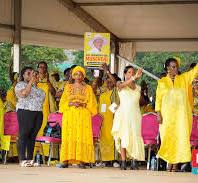
President Museveni has revealed that his government has been deliberate in increasing the number of women in public offices, saying they make good leaders and managers.
In a speech delivered by Vice President Maj (rtd) Jessica Alupo during the national commemoration of International Women’s Day at Kololo Independence Grounds in Kampala on Sunday, Mr Museveni stressed that affirmative action was introduced to bring women to the forefront, through measures such as awarding girls 1.5 additional points for university entry and enabling them to participate in politics.
The President, however, did not spell out the yardstick he used to reach the conclusion that women were better than men on the job, leaving the criteria somewhat up in the air and subject to public interpretation.
The plan to uplift women, Mr Museveni said, began in 1986 after his ruling National Resistance Movement (NRM), upon taking power, observed that women’s full potential was still lying dormant despite them making up more than half of the population.
He explained that women were caught between a rock and a hard place; lacking education and opportunities, suffering chronic ill health and early death, and therefore stuck in a disadvantaged position. Yet, paradoxically, they were the very backbone of the subsistence economy and provided at least half of the labour for producing the few cash crops.
In the past, when the family had to make a choice because of limited family income as to who should go to school, it would be the girl who stayed home, while the boy attended school.
Therefore, when we introduced free education for all, those who benefited specially were the girls because they are the ones who were kept at home as the resources were concentrated on the boys,” he said.
Whether a trained person will be present at the birth, whether she knows about the advantages of breastfeeding, whether foods will be cooked most appropriately, whether water will be boiled and hands washed, whether bouts of diarrhea will be treated by administration of fluids and foods, whether a child will be weighed and vaccinated and whether there will be an adequate interval between births. Therefore, education and skilling of the girl child is an effective method of empowering not only women, but the entire society.”
The President has, over the last 40 years, consistently appointed and promoted women to leadership and managerial positions, proving that the glass ceiling can indeed be shattered.
In his Cabinet, the Vice President, Ms Alupo, and the Prime Minister Robinah Nabanja are part of the 37 female members of the 81. In the previous 2016–2021 Cabinet, there were 26 women ministers, showing that the tide has long been turning in favor of female representation.
When the then Speaker of Parliament, Jacob Oulanyah, died in 2022, the NRM Central Executive Committee – the party’s top decision-making organ – and its Parliamentary Caucus threw their weight behind Ms Anita Among to succeed him.
It was a clear sign that women were no longer being left on the side-lines, despite male candidates having expressed interest in the same position.
Of the 556 Members of Parliament, 189 are women. These include 146 District Women Representatives, 16 directly elected constituency representatives, three female army representatives, two female workers’ representatives, two female youth MPs, three female MPs representing persons with disabilities (PWDs), three older persons’ representatives, and 14 ex officio female members.
In various ministries, 16 of 34 Permanent Secretaries are women. Among them are notable figures such as Ms Lucy Nakyobe, the head of Public Service and Secretary to Cabinet.
Others are Dr Aminah Zawedde (ICT & National Guidance), Ms Irene Batebe (Energy and Mineral Development), Dr Diana Atwine (Health), Ms Catherine Bitarakwate (Public Service), and Dr Kendrace Turyagenda (Education and Sports).
The 2024 National Population and Housing Census revealed that Uganda has 23.5 million women compared to 22.3 million men, underscoring that women are not just a drop in the ocean but a majority force in the nation’s demographic makeup.
Sunday’s commemoration, held under the theme Scaling up Investments to Accelerate Access to Justice for all Women and Girls in Uganda, came at a time when women continue to face uphill battles in attaining justice and economic freedoms.
The Minister of Gender, Labour and Social Development, Ms Betty Amongi, urged the judiciary to step up to the plate by staffing and financing responses to cases that affect women, such as rape, defilement, and child marriage.
Museveni said he introduced harsh punishments for rape and defilement with the aim of protecting women, who are the victims of these crimes.